Print Story
X




What went wrong – and right – for media freedoms in Pakistan
| B |
etween May 2024 and April 2025, Pakistan’s media industry found itself at a crossroads, grappling with mounting legal restrictions, financial instability and escalating threats to journalists. The state enacted new legal provisions for use as tools for silencing dissent and enabling it to detain, fine and imprison journalists, political activists and human rights advocates for their online expressions.
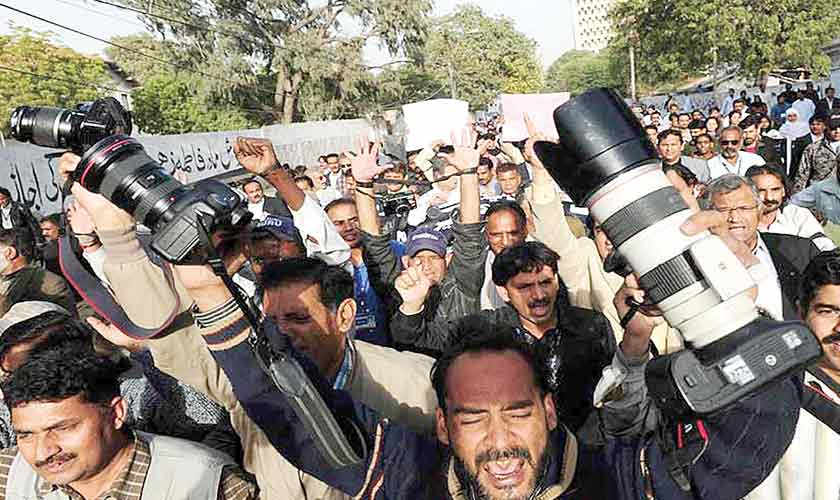
In this period, the challenges facing journalists intensified. Safety concerns and job insecurity escalated as independent journalism came under increasing pressure. A lack of unity among media professionals weakened collective resistance against growing censorship even as individual protests grew. Economic hardship deepened the crisis forcing many news outlets to drastically downsize.
Beyond its financial woes, the Pakistani media industry is struggling with declining professional standards, a lack of diversity in leadership and inadequacy of resources to adapt to digital transformation sweeping the landscape. With an increasingly intolerant state expanding its control over media freedoms, the ability of journalism to serve as a watchdog for democracy and public interest came under serious threat in the period under review.
On the plus side, some initiatives materialised that raised the prospects of improvement in internet accessibility and quality and additional resources for the welfare of journalists. Another silver lining was a closing of ranks between the Pakistani media and civil society to jointly defend constitutional guarantees of freedom of expression and diversity and pluralism in media narratives.
The negatives
Five ways freedom of expression and public interest journalism were challenged:
1) Content takedowns and internet slowdowns: The state employed restrictive measures such as prolonged bans on social media platforms, including X, internet shutdowns and throttling of internet access against journalists and political activists. Amendments to the cybercrime law criminalised the dissemination of ‘fake news’ and imposed stiff penalties, posing serious threats to free speech and digital journalism.
2) Legal shackles on free speech: The state enacted new measures to toughen the legal regulatory environment for freedom of expression and public interest journalism. The Prevention of Electronic Crimes (Amendment) Act, 2025, criminalised misinformation and expanded government control over online content by the establishment of a Social Media Protection and Regulatory Authority with extensive oversight powers. The Punjab Defamation Act, 2024, allows legal action without proof of actual damage and imposes fines. The establishment of an anti-propaganda task force by the government in 2024 further clouded freedom of expression.
3) Violence against journalists: There was a major uptick in violence against media practitioners with over 80 journalists documented as victims of various violations. Of these, at least 8 were killed and more than 30 attacked or wounded, according to the International Federation of Journalists and Freedom Network. Legal cases, arrests and threats against journalists, rights activists and political workers were prevalent, with many facing consequences for their professional work.
4) Deteriorating dissent and degrading democracy: The 2024 national elections saw a shift towards digital campaigning but contributed to heightened polarisation. The government implemented restrictive measures, including bans on media platforms and legal actions against political activists and journalists. These actions stifled free speech and dissent, undermining democratic principles and escalating social unrest.
5) Women in media still striving for equality: Despite some improvements, women remain under-represented in the media sector, particularly in leadership roles. New studies by the International Federation of Journalists and International Media Support revealed significant gender disparities in employment numbers and representation in journalists’ unions and press clubs, stressing that targeted efforts were needed to address these disparities and promote gender equality within the media industry.
The positives
Five opportunities in defence of open civic spaces and inclusive public discourse:
1) Hi-speed satellite internet: Pakistan undertook initiatives to enhance its internet connectivity through satellite technology. In May 2024, Pakistan launched its own multi-mission communication satellite, PakSat-MM1, jointly developed by Pakistan Space and Upper Atmosphere Research Commission and China Great Wall Industry Corporation. Industry sources say this is expected to expand hi-speed internet connectivity and provide advanced communications across the country and benefit journalism, governance and digital economy.
2) More citizens online and on social media: Over the past year, the number of broadband internet users in Pakistan increased to 145 million – a 60 percent population penetration. In the same period, the number of social media users above 18 years of age rose to 71 million – a 27 percent population coverage, according to Data Reportal. Of these social media users, 71 percent were male and 29 percent female. While there have been increases across these ranges, there still exists a significant digital divide with low penetration in many regions.
3) Growing solidarity with media by civil society: Increased restrictions triggered expanding solidarity by the civil society with the beleaguered media. In May 2024, over 80 civil society organisations and journalists united to oppose the Punjab Defamation Bill, 2024, criticising it as “draconian and regressive.” In early 2025, controversial amendments to the cybercrime law, PECA, led to significant backlash and solidarity actions aimed at defending free speech. A coalition of rights groups and media associations was formed to oppose the amendments. A joint resolution was adopted at another national meeting convened by Human Rights Commission of Pakistan calling to repeal the amendments. The International Federation of Journalists, Reporters Without Borders and Amnesty International also expressed support.
4) Judicial activism in defence of freedom of expression: Pakistan witnessed significant judicial activism in favour of protecting freedom of expression as various legal challenges were mounted against media restrictions and laws perceived to infringe upon freedom of expression. Writ petitions, including those challenging the PECA (Amendment) Act, 2025, were accepted by the Supreme Court and High Courts in Islamabad, the Punjab and Sindh. Challenge to the Punjab Defamation Act, 2024 was also admitted in the Lahore High Court. All these courts put the relevant federal and provincial governments on notice.
5) Enhanced journalist welfare: In October 2024, the Balochistan government increased the allocation for its Working Journalists Welfare Fund from Rs 230 million to Rs 500 million, alongside an additional allocation of Rs 200 million for the Quetta Press Club. In January 2025, the Khyber Pakhtunkhwa government granted Rs 50 million to the Peshawar Press Club and raised its Journalists Welfare Endowment Fund to Rs 200 million while also committing to the provision of residential plots for journalists. In March 2025, the Punjab government doubled its Journalist Support Fund from Rs 50 million to Rs 100 million and introduced subsidised healthcare services for media professionals. In November 2024, it also allocated over 3,000 residential plots for journalists in Lahore.
The writer is a media analyst and media development strategist based in Islamabad. He can be reached at adrehmat@gmail.com