Print Story
X




The show Beyond DNA1 explores whether style, biology or experience defines an artist
| A |
professor interviewing applicants to an art and design institute attempts to trace the impulses, reasoning and desires that drive these young individuals, including those with no early exposure, to choose a profession that is neither common nor lucrative in the society. The probing faculty members begin to observe differences between aspiring students and their siblings: preferences in music, film, food, fashion and politics, as well as more serious aspects such as independent views on life, work, the world, faith and fate – and, most noticeably, in their body language.
The differences become clearer upon meeting their families and realising that it was not the art school that made them artists – they were born with this inclination. The institution merely helped shape it.
However, while unique at the beginning of their creative journey, these individuals soon, like their predecessors, acquire a distinct style, which eventually becomes the DNA of the artist’s identity: a set of elements that distinguishes them from other professionals. In some cases, this style is self-generated; in others, it is imposed by collectors, critics, galleries or contemporaries.
Artists respond to this natural or constructed code in various ways. Some, content with its presence, continue producing work with little change – except perhaps in volume, scale, or colour palette. Others, more astute, seek a middle path, mirroring the fashion world, where each designer or brand introduces a new range every season. Yet, the changes remain moderate and largely superficial. For these artists, the challenge is akin to walking a tightrope. Still, they manage to captivate their audience, consumers who seek a different label from the same maker.
In other instances, creative individuals consciously break away from a fixed style – or return to earlier idioms, now informed by new knowledge, tools and ideas. In such cases, a retrospective exhibition may reveal such varied work that one struggles to connect it to a single artist. Philip Guston is perhaps the most fitting example: the celebrated painter, known for his sensitive, sensuous and softened application of paint in abstract compositions, later deviated dramatically, adopting a visual language of caricature-like figures, objects and urban settings.
Another name that often surfaces in this context is Marcel Duchamp, who challenged the very identity – and therefore the stylistic expectations – of an artist. In 1917, he submitted a factory-made porcelain urinal, signed ‘R. Mutt’, to the Armoury Show. The work was rejected by the organising committee, but, ironically, it is now regarded as a landmark of Duchamp’s aesthetic and conceptual legacy.
In fact, the association of ‘style’ with an artist is a relatively modern phenomenon. For centuries, image-makers were not preoccupied with style. They pursued excellence, fulfilled the demands of patrons, or engaged with religious, spiritual, secular, philosophical, literary or scientific subjects. Even today, some artists do not consciously seek a style – yet, like a person’s voice, it emerges naturally, regardless of what they express.
Vincent van Gogh, for instance, wanted to paint sunlight, his surroundings and the world he knew. Yet, despite the variety of his subjects, every painting bore an unmistakable imprint – Van Gogh’s signature touch – without his full comprehension or intent.
In contrast, those who deliberately develop a unique style recall a popular craze among children I witnessed during my school days. Everyone was practicing how to sign their name. Notebooks were filled with endless attempts at forming a signature – believed by each child to symbolise their future identity, success and stature. Artists who construct a recognisable style are, in some ways, not far removed from those schoolboys (aside: one of them now has to visit the bank regularly to verify his signature!).
The work raises a compelling question about a woman’s recognition: is she to be identified by her face or by the reproductive parts of her body?
The power of style, by and large, becomes an omnipresent force in the realm of art, often rendering artists oblivious to the possibility of working in two or more modes simultaneously. Pablo Picasso exemplified this capacity: for years, he created two stylistically disconnected canvases in a single day – one semi-realistic, the other radically simplified. In paint, he demonstrated what Walt Whitman once confessed in poetry: “Do I contradict myself? / Very well, then I contradict myself. / (I am large, I contain multitudes).”
Beyond DNA1, a project by RM Studio (led by Sadaf Naeem and Saulat Ajmal), brought together artists from diverse backgrounds and practices to explore how, in the words of the curators, “through their work, these artists challenge us to consider the ethical, philosophical and aesthetic dimensions of DNA.” The group exhibition (April 8-29 at ‘O’ Art Space, Lahore) encouraged “a deeper understanding of the code that underlies existence” by inviting 18 participants to render both their facial identity and the identity of their art, each through two separate artworks.
Through this curatorial premise, each artist was asked to split a single identity to produce two versions of self. The most significant idea that emerged was the nature of DNA and the malleability of style. A human being cannot alter their DNA, but style, unlike genetic code, can be consciously modified. Hence, the show raised a provocative question: is style essential, or merely an artistic by-product?
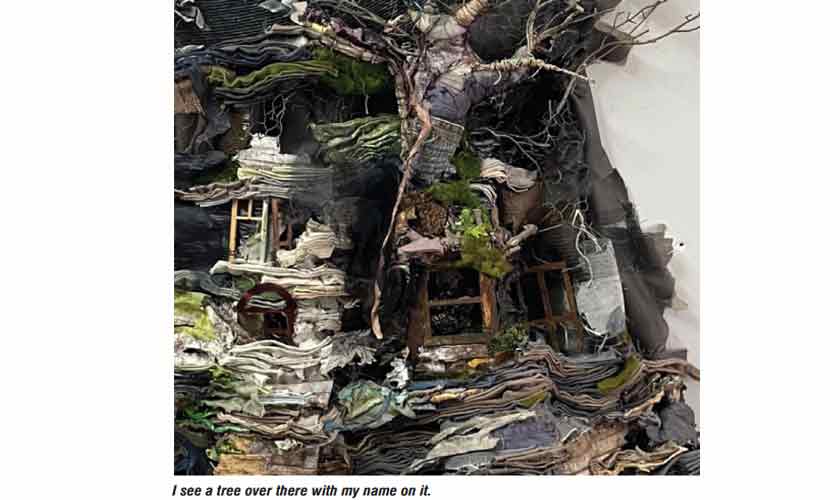
Each artist, by submitting paired pieces, seemed to reflect on this puzzle. Some responses were as fixed and precise as passport photographs; others were as unpredictable as they were imaginative, offering contradictory, even conflicting dimensions of the same creative self. Most participants approached the show’s theme in unexpected ways, yet managed to connect two seemingly disparate artworks to a coherent personal identity.
For example, Nausheen Saeed’s Self Portrait (video, 11 min 10 sec), which shows the sculptor casting her own face, was paired with Vessel (painted fibreglass) – a life-cast of a woman’s body from mid-torso to upper thighs. The work raises a compelling question about a woman’s recognition: is she to be identified by her face, or by the reproductive parts of her body? In a male-oriented society, is her identity shaped by her independent self or by her biological role?
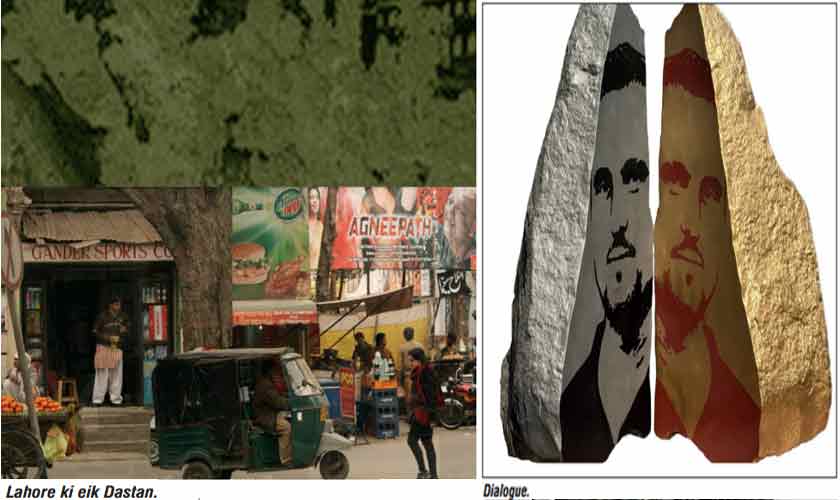
This notion of physical division of the self also featured in the work of another sculptor, Jamil Baloch. In his piece Dialogue, Baloch explored questions of style and physical identity by slicing a gold-covered fibreglass rock in half and layering each inner surface with his own face, set against a flat background. The seed-like sculpture, when opened, revealed the hidden identity of its maker.
The issue of whether identity is inseparable from an artist’s practice was also explored in the work of Farida Batool. Taking a bold approach in her diptych, Lahore ki Ek Dastaan (lenticular print), she composed scenes from the city interwoven with images of herself on the road. The construction of the work reinforced the idea that an artist’s creation is not separate from the artist – it emerges from within.
This concept was echoed in Amean J’s two photographic prints. His self-portrait (Out of Focus) closely mirrored his image of the Arabian Sea (Seascape) in size, tone (black and white), resolution (blurred) and medium (UV print on Canson paper).
Together, the work provoked deeper questions: What constitutes a creative individual’s DNA? Is it chemistry, ancestry, training, environment or something else altogether? Does the artist shape the work or does the work shape the artist? These are questions that confront creative practitioners daily – in studios, study spaces, theatres and in front of the camera.
Beyond DNA1, curated and exhibited by Sadaf Naeem and Saulat Ajmal, was an intelligent and imaginative exploration of these ideas – speculative, open-ended and rich with possibility.
The writer is a visual artist, an art critic, a curator and a professor at the School of Visual Arts and Design, Beaconhouse National University,Lahore. He can be contacted at quddusmirza@gmail.com.