Print Story
X




India ‘suspends’ Indus Waters Treaty alleging Pakistani role in Pahalgam attack

| I |
ndia is once again in the grip of war hysteria against Pakistan. After the Pahalgam attack, its right-wing media, ethically duty-bound to play a role in peace-building, has been pressing the government to launch a war against Pakistan. Pakistan, for its part, has offered to cooperate for an independent and impartial probe into the Pahalgam attack. The offer has not been accepted. Let us take a look at what has happened so far and what it is likely to lead to.
On April 22, mainstream Indian media running routine transmissions went for breaking news about an attack on tourists at a Pahalgam resort at 2.45pm. Within 20 minutes, it started accusing Pakistan of having master-minded the attack. The media described the attackers as ‘infiltrators.’ This, as some Indian politicians and security analysts pointed out, implied a serious security and intelligence failure. Next, the Indian government announced its decision to suspend the Indus Water Treaty and instructed all Pakistan citizens in India to leave the country. By way of a response, Pakistan closed its airspace to Indian flights while sticking to its offer for an independent inquiry.

The general perception after the attack is that the Modi government is trying to exploit the situation to win the upcoming elections in Bihar and other states in November 2025 and onward. At the same time, it is using the attack for illegally abrogating the Indus Water Treaty.
Pahalgam is situated nearly 270 kilometres from the Pakistan border via mountainous terrain and about 400 kilometres by road. The region is heavily forested, isolated from main road networks, and can only be accessed on foot or by horse/ mule for the final 20 kilometres. Each year, Pahalgam attracts nearly 200,000 pilgrims from across India for religious tourism. Since 1993, the area has witnessed several targeting these tourists resulting in numerous fatalities. At the time of the most recent event, around 2,000 tourists were present in Pahalgam. Despite its geographic isolation and religious importance, the continued absence of adequate security arrangements reflects gross negligence.
The general perception after the attack is that Modi’s government is trying to exploit the situation to win the upcoming elections in Bihar and other states in November 2025 and onward. At the same time, it is using the attack for illegally abrogating the Indus Water Treaty.
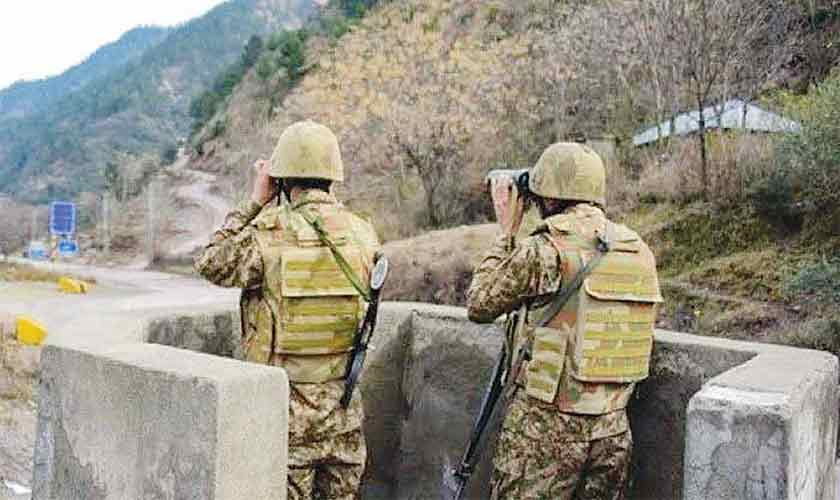
Indian Occupied Jammu and Kashmir hosts a staggering security presence, with around 700,000 military personnel and over 200,000 paramilitary troops—nearly one security officer for every seven civilians. This makes it the region with the highest ratio of security personnel to population anywhere in the world. Indian security analysts claim that the region is protected by a comprehensive, multilayered security and intelligence apparatus. This includes continuous satellite surveillance, round-the-clock monitoring using infra-red and motion-sensitive CCTV systems, drones and human intelligence networks. On the ground, nearly 900,000 security personnel are deployed in layered formations along the border and across populated areas.
Given such extensive and sophisticated surveillance, the claim that 4 to 6 alleged militants could traverse 270-400 kilometres of rugged terrain on motorbikes, armed with AK-47s, kill more than two dozen pilgrims over the span of 30 minutes, and then escape unchallenged, strains credulity. If, for argument’s sake, this were indeed a case of deep cross-border infiltration, then it stands as a damning indictment of the intelligence and operational capabilities of the world’s third-largest military.
At one point, the ISPR DG said the Pakistani expected a major offensive by Indian military. The assessment was shared at a press talk at which Information Minister Atta Tarar, Foreign Minister Ishaq Dar and Defence Minister Khawaja Asif were also present.
Air Commodore Zahid-ul Hassan (retired), a defence analyst, who was on a key position when Pakistan shot down two Indian fighter jets in Balakot in February 2019, tells The News on Sunday, “There is less chance today that India will repeat the 2019 mistake. Pakistan Air Force is far better equipped now as compared to 2019. India can, however, go for small kinetic or non-kinetic initiatives.”
“Among kinetic measures, India can use light/ heavy artillery across the Line of Control and working boundary; this will draw a similar response. India can also use rocket attacks that will also be retaliated as per strategy,” he adds. “Knowing the capability of Pakistan’s Air Force and Navy, India will refrain from any adventure on these fronts,” says Zahid. “In 2019, we could have shot down five more aircraft of the India Air Force but we followed our deterrence policy and let them go.”
He says that under non-kinetic measures, India has already suspended the Indus Water Treaty, which is illegal. It has also deported Pakistanis from India and is trying to implicate Pakistan in the attack in its briefings to the diplomatic corps.
In this scribe’s own opinion, India might target some religious seminaries that have in the past been associated with Lashkar-i-Taiba or Jaish-i-Muhammad to pacify its war-mongering media using drones which might be intercepted.
The war hysteria might calm down a bit after the US intervention as Marco Rubio spoke to Indian and Pakistani leaders. For his part, Prime Minister Shahbaz Sharif has again stressed the need of an independent and transparent inquiry.
The author is a senior journalist, teacher of journalism, writer and analyst. His X handle: @BukhariMubasher