


Print Story
X




The unending struggle of Sindh’s fisher people
| P |
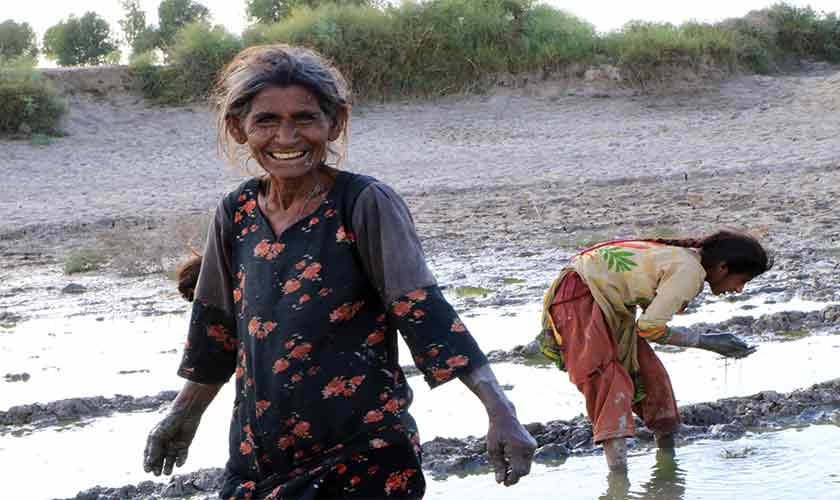
overty and starvation compel individuals to opt for paths that may be unsuitable or unsafe for them, yet they follow that route. Hunger and destitution have driven women living in villages near Jati town in Sujawal district to catch small fish, commonly referred to as “trash fish,” to alleviate their hunger. Haliman and Sukhan, residents of a village of thatch huts near Jati town, leave their homes every day in search of partially dried ponds and water channels. They use buckets made of thin cloth attached to a stick. “Water scarcity has brought misery to our lives. We (fishermen) are left with no option but to find trash for our daily food,” says Sukhan, a middle-aged woman whose husband, also a fisherman, has gone for fishing in the high seas, following an alarming shortage of fresh water in the region.
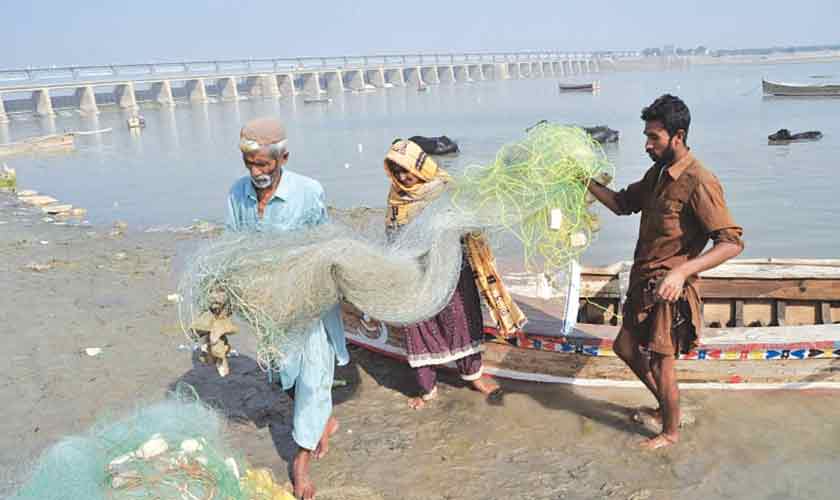
The coastal areas of Sindh - Badin, Thatta and Sujawal - have a fishing tradition. The communities residing along the bank of the Indus River and the coastline rely on fishing as their pivotal source of livelihood, besides making mats and shelters from straw and weed and selling lotus. The ongoing water crisis and its effect on biodiversity have affected the fishermen community.
The coastline of Sindh, stretching over 350 kilometres, has seen a persistent crisis for the past two decades. The crisis has brought things from bad to worse. Rabia, a twenty-year-old, waits for her mother to return with trash fish so that she can cook it for dinner. “My Baba has gone into the high seas for fishing; he will return in two months. Until then, it is the responsibility of my mother to lead our family and make arrangements to feed us,” says Rabia, adding that her mother also resorts to selling stems of trees that are used as fuel in remote areas.
Historian Zahid Lohar says that the fisherwomen of Sindh are experts at catching fish even from the deep waters of freshwater lakes. They would venture into freshwater lakes, water channels and ponds in search of local fish species and then sell it in markets and villages. He said that the fisherwomen would fix a net at the side of the lake to cause a fish trap. This method is locally called jhol. Sharing her experience about this method of catching fish, Rohmat Bai, another fisherwoman from Juman Malah village of Jati taluka, says that they also use their dupatta (scarf) as a net to locate and catch small fishes in nearby ponds.
Fish species locally known as theli (Catla), dayo (tilapia), khagga (cat fish) and mundo (black fish) are found in many nearby lakes, ponds and water channels. These are used as daily food by the local fishermen community amid shrinking opportunities for livelihood.
Environmentally speaking, the coastal region has been degrading for two decades. The fishermen have been the worst sufferers, following the extinction of several fish species, destruction of freshwater lakes and scarcity of water.
Environmentally speaking, the coastal region has been degrading for the past two decades. The fishermen have been the worst sufferers, following the extinction of several fish species, destruction of freshwater lakes and scarcity of water. The fishermen community of Sindh has been among the most underprivileged communities of the country.
This community has been directly affected by the shifting weather availability patterns and the impacts of climate change. Umer Khaskeli, a social activist closely associated with the fishing communities of Thatta and Badin districts, says that the coastal areas of Sindh have not been receiving the required amount of water. This has led to a significant drop in the water level at local freshwater lakes. Some of those have dried up. Sea intrusion, he says, has contributed to the devastation of freshwater lakes. “The famous natural lakes of the past – Chaubhati, Til, Chann Bhelo, Karr, Kalkaan Channi and many others have vanished. Today there is no sign of their existence,” he says. “Fishing in this region is as old as the Indus River and The Arabian Sea,” says Hanif Malah, quoting from the poetry of Shah Abdul Latif Bhittai, Sindh’s iconic poet who had narrated the love of King Jam Nizamdin, who became a fisherman to persuade Noori, a fisherwoman, to marry him. Noori lived in a slum along the bank of the famous Keenjhar Lake.
He says that the constant shortage of water has not only led to the parching of lakes but also caused the annihilation of some fish species. “Tenualosa ilisha, locally called palla; gudusia chaprais, commonly called the pallery; barbus saranais, belonging to the family cyprinidae and commonly known as popro; and cirrhinus mrigala, locally known as morakhee, are all on the verge of extinction,” Hanif Mallah warns.
Declining opportunities for livelihood have compelled many families of fishermen to migrate to other districts of Sindh. They have migrated variously to Jamshoro, Nawabshah, Sanghar and Dadu, looking for a living. Journalist Iqbal Jakhro says that several villages near Kharo Chann, Shah Bunder, Kothi, Jati and Golarchi towns present a desolate look as the fishermen residing there have moved to other areas.
Answering a question regarding government initiatives, he says that those have not had much success either on account of rampant corruption or a failure to foster awareness among the beneficiary communities. He says that NGOs like the Pakistan Fisher Folk Forum and Coastal Development Organisations, among others, have made consistent efforts to improve the quality of life of the fishermen but failed.
The author is a practicing lawyer and a freelance journalist. His areas of interest include cultural diversity and socio-politics. He tweets as @ZainSha1 on X.