

Print Story
X




Despite clear evidence of reduced supply this year, the wheat market remains volatile
| T |
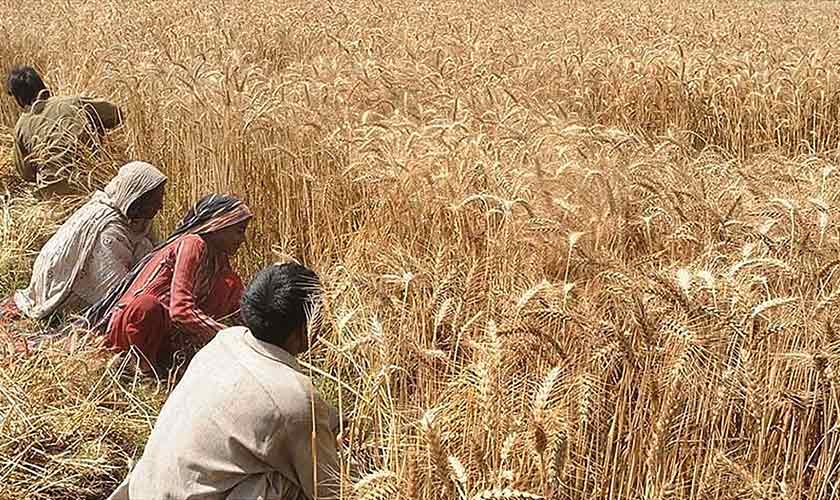
he political economy of wheat shall always remain integral to agricultural planning. We need an average of 120 kg/ head a year to meet the minimum calories required. As such we will need 39-40 MMT a year by 2035 against a projected production of 33MMT. We have had years of import (mostly) and export (2016-2019) of wheat depending on the cultivated area and climate consequences. One thing has remained constant: the annual population growth of 2 percent. The challenge remains to feed the growing population.
The international wheat prices fluctuate according to the crop conditions in the major grain supplying countries: the USA, Canada, Australia, Russia and Ukraine. In the subcontinent, since the days of Green Revolution, wheat policy has always dominated the official agricultural policy narrative of the governments. The domestic market prices and government-announced minimum support price (MSP) have generally been lower than the international market. According to Food and Agriculture Organisation of the United Nations, the global market price of wheat is 3 percent lower this year than the previous year. It is still about 30 percent higher as landed cost compared to the current market price in Pakistan.
In the year 2023, after the Sindh government announced a Rs 4,000 per 40kg MSP and the federal government followed with Rs 3,900 per 40kg, the open market touched Rs 5,000 in the following months. The farmers then started growing more wheat. The year 2024 saw a record production of 32 MMT. The governments however walked out of promised public procurement and the market crashed. However, there was no respite in the input market forcing farmers to buy expensive inputs resulting in a higher cost of production.
We were tasked with forecasting the future of wheat. A structured survey in eight districts of the Punjab was conducted during July-August 2024. A series of consultation sessions followed. We predicted a 17 percent reduction in the cultivated area of wheat in the upcoming Rabi season. 26 percent of large farmer (>25 acres) were expected to switch for alternative crops; 26 percent of medium land holding (12.5-25 acres) farmers and 13 percent of small farmers (<12.5 acres) were also expected to do so. The determining factors included policy initiatives by the governments, weather and water situation and the availability of alternative crops. The actual cultivated area in the Punjab (in 2025) was 16.25 million acres, compared to 17.44 million acres a year earlier. The less than predicted reduction in the cultivated area is attributable to a better campaign by the provincial Agriculture Department.
There is a view among policymakers that farmers have no choice but to grow wheat. The assumption is valid mostly in an economy dominated by small farmers where ‘food security first’ dominates the household decisions.
Last month, our Precision Agriculture Lab carried out a satellite image analysis of wheat acreage in the Punjab. It revealed a 9.63 percent reduction in acreage during the 2025 harvest season compared to the preceding year. We have also conducted a satellite-based yield estimation using biophysical modeling across four agro-ecological zones in the Punjab. The analysis predicts a yield reduction of 7 percent compared to the 2024 harvest when average yield was 34.74 maunds per acre. Together, the two factors indicate a 12 percent reduction in output. [The actual numbers are expected to arrive in a month’s time.]
Despite clear evidence of reduced supply, the wheat market has crashed for the second consecutive year. While I support the government’s decision to deregulate, with or without IMF prescription, I also consider it imperative for the government to ensure a level playing field across the wheat value chain. The welfare of the urban consumer is important; however, it should not come at the cost of the peasantry.
The year 2024 saw record production of 32 MMT. The government walked out of promised public procurement and the market crashed. However, there was no respite in the input market forcing farmers to buy expensive inputs resulting in a higher cost of production.
Historically, public procurement at MSP ranged 4-6 MMT. The flour mills and private dealers were the other major buyers in the field. The MSP determined a price threshold that used to be maintained by restricting movement of the commodity. The government then announced quotas and release prices for flour mills. In line with the principle of deregulation, the government has removed the inter-provincial restriction on wheat movement. However, the cross-border trade is still regulated. The release of government stocks to the flour mills during the arrival phase of fresh wheat harvest is another important factor in the market crash.
Agricultural markets in general are imperfect. The wheat market is hardly developed as governments-have been controlling prices and procurement. The abrupt withdrawal has created a crisis that offers an opportunity for the market to develop fast. The Punjab government has launched an electronic warehouse receipts (EWR) system. This is a commendable initiative. However, for the current year, it is already too late. While it offers an interest-free investment opportunity, the system will take some time to mature. The logistics and capacity building among stakeholders are a slow process. The access to storages, grading and quality control, collateralisation of the commodity and some yardstick for pricing based on the cost of production (indicative price) need to be settled. Strict monitoring by the government will be required to maintain a competitive environment and to discourage the cartels.
One could learn from the experience of system transformation across the border. The Modi government tried to walk away public procurements through a series of enactments. That was resisted by the farmers through prolonged sit-ins around the capital, New Delhi. The government was then forced to withdraw its market reforms laws. That was followed by two major initiatives i.e. incentives for warehousing and introduction of stringent conditions for the release of wheat to the flour mills from government stocks. The flour mills were mandated to maintain a minimum stock level through purchases from the open market to qualify for the government-provided quota. In the current season, India is expected to harvest a record wheat crop of 115 MMT, compared to the recent average of 103 MMT. Both the government and the private sector (flour mills in particular) are buying from the market. The open market price is significantly higher than the government-offered MSP. The government has opted not to restrict the commodity movement. The current market share of flour mills is around 10 percent - compared to the traditional 3 percent. The lesson here is to control exploitation by a segment that has been at the heart of wheat ‘corruption.’
A long-term solution lies in ensuring sufficient supplies by making agriculture precise, cost effective and resource efficient. The time is ripe to transform wheat into a competing crop, rather than a protected one. The examples of maize and rice are before us. The governments no longer control the markets and the farmers have made significant investments in the application of modern technologies.
That wheat yields can be optimised by using quality seed treated with fungicide; timely sowing using drills instead of broadcasting; balanced use of fertilizer; timely application of effective weedicide; and preventing harvesting operation losses through obsolete harvesters is a no brainer. Reducing the gap between the average national output and the potential yields could translate into 100 percent or higher gains. The limiting factor is the farmers’ access to and absorption capacity for technology. A range of service providers and value chain management options are emerging. These include supply of quality inputs, farm machinery and credit as a one-window operation offered by a private bank. Green Agri Malls is another initiative of the GPI with similar objectives. The Kissan Cards offered by the Punjab government have benefitted 0.6 million farm households.
Long-term salvation lies in making better water management a top priority. Soil health and climate adoption/ mitigation are others. Wheat, the single largest crop, also consumes the largest share of irrigation water through flood irrigation. The rice-wheat system consumes 68 percent of the irrigation water. Conversion from flood to furrow/ bed irrigation can save up to 40 percent of irrigation water applied to these crops with better crop stand and yields due to mandatory seed drilling instead of broadcasting the seed.
I propose that our policy makers develop a 3-5 years incentive plan to equip 0.5 million tractors with a bed planter each. The estimated cost of this simple transformation is around Rs 250 billion. This will be instantly recovered as a water saving that can be further augmented by announcing a higher rate of flood irrigation water rates (abyana) compared to furrow irrigation. The farmers will quickly switch from flood irrigation to furrows. The water saving from wheat-rice system will be enough to run the proposed new canals while ensuring our food security for a long time.
The writer is a former vice chancellor of the University of Agriculture, Faisalabad