Print Story
X

“It’s only because of their stupidity that they’re able to be so sure of themselves.”
— Franz Kafka, The Trial (1998), Schocken Books. p. 117.(1925)
| O |
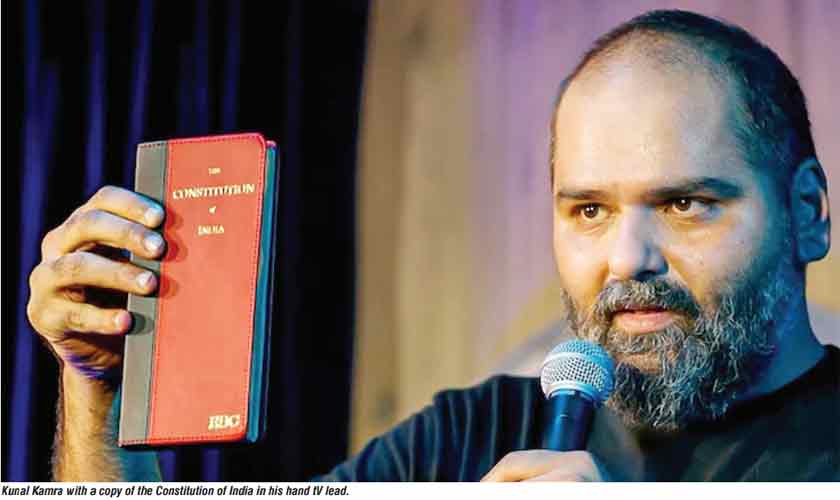
On April 5, stand-up comedian Kunal Kamra found himself again, not in the spotlight on a stage, but in the crosshairs of India’s legal machinery. His legal team filed a petition before the Bombay High Court to quash an FIR accusing him of defaming Maharashtra’s Deputy Chief Minister EknathShinde, during a live performance. The case, hinging on a satirical parody of a Bollywood song, has now spiralled into a large political theatre involving state-backed intimidation, procedural coercion and threats to his safety.
As Kamra awaits a hearing on April 16, the absurdities of the case evoke a chilling parallel with Kafka’s The Trial, where the protagonist is caught in a relentless, irrational system, condemned not for what he has done but for daring to exist. The sheer absurdity of Kamra’s legal troubles should leave everyone questioning the state of free speech in India.
What might once have been dismissed as another episode in Kamra’s storied career of provocation, now lands differently. The political supporters’ vandalism of his performance venue, FIR lodged by a Shiv Sena MLA and the court’s response paint a bleak portrait of India’s contemporary democratic terrain. This isn’t about a joke any longer. It’s about the boundaries of dissent—and who gets to set them.
Kamra’s troubles are not isolated. They are symptomatic of a profound, structural hostility to irreverence in India’s political discourse, where satire is no longer comic relief but perceived rebellion. In today’s India, a stand-up comedian is not merely a performer but also a litmus test for the nation’s tolerance of free speech. The joke, it turns out, is no longer on the establishment; the issue now is about the possibility of telling a joke.
Comedian as
contrarian
In India’s accelerated media ecosystem - hyper-polarised, tribalised and endlessly volatile - Kamra’s voice has cut through the noise with a distinctly unsparing edge. His rise, first through YouTube and later through sold-out shows and podcast appearances, has coincided with the country’s shifting political climate after 2014. The emergence of Narendra Modi’s Bharatiya Janata Party marked not just a change in government but also a profound re-ordering of what could be said in public and by whom.
Amid this, Kamra’s brand of satire - acerbic, political and unrelenting - became more than an act. It became an act of defiance, amplified by the democratisation of digital platforms. The power of technology in shaping public discourse is evident in the way Kamra’s voice has resonated, albeit with little institutional backing and a disproportionately high level of risk. Where earlier political cartoonists bore the brunt of state ire, today, the stand-up comic must navigate both online outrage and offline intimidation.
Kamra is not alone in this. But his case is perhaps the clearest signal that satire has been reclassified, from a cultural irritant to a perceived political threat. The transformation of satire from a form of cultural critique to a perceived political threat is a stark reminder of the weight of censorship on artistic expression. His comedic voice has, in recent years, become emblematic of a particular genre of dissent: sharp enough to unsettle the clear-eyed, sufficient to disturb and stubborn enough not to apologise.
The political context that animates Kamra’s comedy is inextricable from its reception. The BJP’s project of cultural nationalism has thrived not merely by consolidating power but by reshaping the emotional contours of public discourse. In this new landscape, humour is a double-edged sword, capable of exposing hypocrisy and triggering violent reactions.
Kamra’s critics often argue that his satire ‘crosses the line.’ But those in power are continually redrawing that line between critique and defamation, irreverence and insult. The question is not whether Kamra’s jokes are offensive. It’s whether the offence can be used as a justification to criminalise speech that unsettles the ruling class.
Yet, it was the rise of Narendra Modi’s BJP and its nationalist agenda after 2014 that began to sharpen the craft of Indian stand-up comedy. In a nation where free speech, once cherished as a cornerstone of democracy, has become increasingly contested, comedians like Kamra found their voice amidst a political climate increasingly hostile to dissent.
To those unversed in the nuances of India’s political shifts, the past decade might appear as little more than a parade of soundbites and media controversies. Still, for the comedians, it became an era ripe with material. The cultural and ideological tightening under the BJP created a bizarre kind of theatre in which comedians took centre stage, often forced to balance satire with self-preservation and humour with a broader sense of responsibility.
Kunal Kamra’s craft is a response, in part, to this new reality. Known for his irreverent wit and fearless political commentary, Kamra turned the lens of his comedy on the very political power that seeks to silence dissent. His most famous run-ins with authority have not been due to his inability to pull a punch but because he understood the nature of the fight: in a nation with a swelling right-wing populist movement, the comedian was quickly becoming one of its loudest critics. His infamous ‘slanderous’ interaction with Arnab Goswami, for example, transcended the typical comedic gag and became a symbol of rebellion against media consolidation and stifled freedom. It wasn’t merely a moment of personal pique but an act of defiance against the great machinery of political censorship. For many, it was the ultimate realisation that the parodist had become the parody — Kamra’s voice, once again, the object of the mockery he sought to skewer.
The bureaucratic overreach in Kamra’s current case — demanding his physical appearance despite security concerns, issuing multiple police summons and delaying the court hearing — reflects a disturbing tendency: the use of legal process as punishment. It is not the verdict that matters but the ordeal. Like Kafka’s Josef K, Kamra is not battling for innocence but for coherence in a system designed to deny it.
Kafkaesque world
of Kamra
In the Kafkaesque world of Kamra’s ongoing legal troubles, the comedian is entangled in a labyrinthine nightmare that mirrors Josef K’s descent into an illogical and hostile bureaucracy in The Trial. Kamra’s situation, steeped in confusion and indignation, echoes the absurdity of Kafka’s world. In this world, power is abstract and arbitrary and an individual’s attempts to find justice are met with obstruction and hostility.
Kamra’s very act of satire, which was meant to entertain and provoke thought, has now become the basis for criminal prosecution — a Kafkaesque turn that leaves him, like K, questioning the very system that seeks to neutralise him. His failure to submit to the demands of the political machine to offer the apology expected of him places him in direct conflict with a system that demands both compliance and self-censorship in the name of political propriety.
The contrast between Kamra’s situation and Kafka’s characters is revealing. While Kamra’s comedy, which targets the political elite with sharp wit, is deeply subversive, it is not violent and does not incite any real harm. Yet, like Kafka’s Josef K, Kamra finds himself entangled in a world that seems to punish him not for the substance of his actions but for his very existence within a system that seeks to neutralise him. The legal threats, the media fracas and the demands for his submission to physical questioning are all parts of the Kafkaesque machine. This machine is indifferent to reason, justice and an individual’s rights.
A state as parody
There is something deeply ironic, almost tragic-comic, in Kamra’s evolution from cultural satirist to legal defendant. He began as a provocateur, poking holes in public personas and political dogma. Now, he’s a symbol of a more profound national anxiety, about how much dissent a democracy can stomach before it starts to gag.
The more absurd the charges against him become, the more symbolic his persona grows. Kamra is not merely performing now; he’s being performed upon. His comedic identity has been overtaken by the spectacle he used to mock. In an environment where every punchline invites litigation and every show is a potential flashpoint, the stand-up comic is less a jester and more a frontline dissident.
The most cruel twist in this saga is that Kamra’s opponents have unwittingly confirmed the very critiques he levels against them. By pursuing criminal action against a comedian, vandalising a comedy venue and insisting on his bodily presence for a song parody, they’ve acted out the punchlines he would have delivered. The real parody, it seems, is the state itself.
In a nation where laughter once served as a pressure valve for political and social tensions, the joke has now become a weapon, wielded by both sides, but with vastly unequal consequences. The platforms that elevated Kamra; YouTube, X (Twitter) and Instagram, now serve as tools for his surveillance and harassment. The same public that once celebrated the rise of homegrown satire now watches, often silently, as it is prosecuted into silence.
Kunal Kamra’s case may ultimately be decided in a courtroom, but its implications reach far beyond legal precedent. This is a test of India’s cultural elasticity — its ability to accommodate critique, irreverence and discomfort without reverting to censorship or coercion.
The comedian has always existed at the edge of society’s norms, laughing from the margins while exposing the absurdities of the centre. In India today, that margin has become a minefield. To stand on it is to risk not just backlash but erasure.
Kamra’s ongoing legal fight is not just about a parody or a performance. It concerns whether satire can exist in a country increasingly allergic to introspection. In this fraught atmosphere, Kamra has come to represent more than his voice. He echoes a democracy in tension with itself — trying to laugh but choking on the joke.
As they say, when power grows thin-skinned, even a joke sounds like a revolution.
Narendra Pachkhédé is a critic and writer who splits his time between Toronto, London and Geneva