Print Story
X




His may be the last generation in this profession but Sagheer, a drummer, has decided to remain true to his craft
| F |
or centuries, music has been a universal language, bringing together people across cultures and generations. Music brings joy with it. It inspires dance and is a medium for stories of love, loss and resilience. In Hyderabad, a community of musicians is staying true to this ancient tradition, but their lives are far from harmonious. They are the unsung heroes of cultural preservation. They struggle to make ends meet in a world that often overlooks their contributions and takes them for granted.
Sagheer Manganhar, a 55-year-old drummer, has spent his life playing the dhol. His hands, rough and worn from decades of practice, move with a precision that only years of experience can bring. His rhythms are the heartbeat of weddings, festivals and religious gatherings, filling the air with energy and celebration.
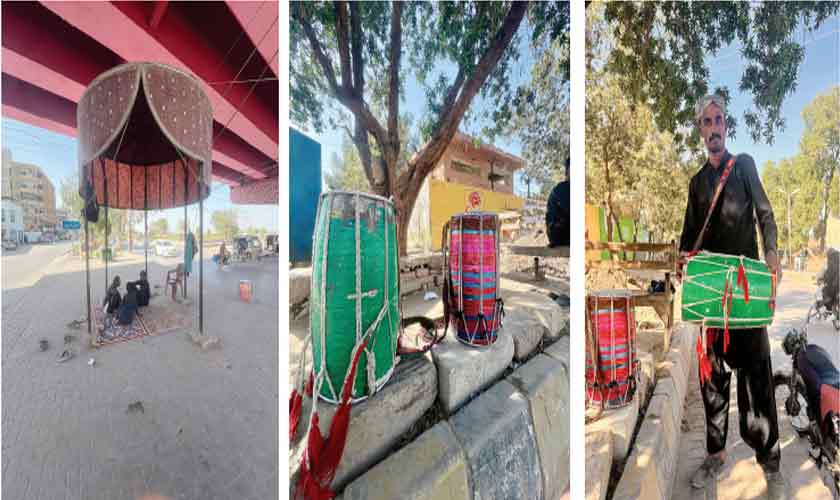
But, for Sagheer, life is anything but celebratory. With no permanent home, he spends his days sitting on footpaths underneath the flyovers of Qasimabad and Latifabad, waiting for someone to hire him.
“We are beggars, trading in melodies,” Sagheer says with a tired smile. “We play the drum to feed our families.”
Sagheer’s story is not unique. He is part of a dwindling community of musicians who have dedicated their lives to preserving traditional music. Their drums, once crafted with care from sheesham or babool wood, hold rhythms deeply woven into the cultural fabric of Sindh.
Previously, musicians like Sagheer were highly valued, invited to celebrations months in advance and paid generously for their performances. But, times have changed and so have the tradations. Modern sound systems have taken over, pushing live music to the margins. Many musicians have moved to cities in search of work, only to find that life there is just as unforgiving.
“We used to earn enough to feed our families,” Sagheer recalls. “Now, we’re lucky if we get 500 rupees for a performance.”
With incomes plummeting, survival has become a daily struggle. Sagheer Manganhar cannot afford to send his children to school and his family lives in constant uncertainty. Despite everything, he keeps playing, finding solace in the rhythms that have defined his life.
“Music is not just sound. It is the heartbeat of our lives,” says Sagheer.
The dhol he plays is a testament to the ingenuity of his community. In the past, drumheads were made from goat hide, but to cut costs, many now use discarded X-ray sheets. The drumsticks, known in Sindhi as dongko and chhanbhi, still produce deep, rhythmic beats that have captivated audiences for generations. Sagheer Manganhaar knows the traditional melodies for every occasion, from weddings to religious ceremonies. His music brings joy to others, yet his own life remains a struggle.
Despite the challenges, Manganhar refuses to give up his craft. He remembers the days when people would dance to his beats, their joy evident in their movements. He remembers weddings where families would eagerly await his performance, treating musicians like honoured guests. Now, such moments are rare. People prefer DJs and speakers and live music has become a luxury that few are willing to pay good money for.
Sagheer has tried to adapt. Sometimes, he teams up with younger musicians to perform at events, hoping that a fusion of old and new sounds will attract attention. But reality remains the same; there is little respect for his craft. Many event organisers try to bargain for lower rates, treating music as an afterthought rather than an art form.
The challenges faced by Sagheer Manganhar and his fellow musicians reflect a larger issue; the slow erosion of cultural traditions. As sound systems and digital music replace live performances, the demand for traditional musicians continues to decline. Many young people in these communities no longer see a future in music, turning to other professions for survival. Some have left to work as daily wage labourers. Others struggle with unemployment, caught between their love for music and the harsh realities of life.
“We are beggars, trading in melodies,” Sagheer says with a tired smile. “We play the drum to feed our families.”
At the same time, there are small efforts to keep the tradition of music alive. Some cultural organisations occasionally arrange folk music festivals, inviting musicians like Sagheer to perform. But these events are not frequent and they do little to provide a stable income.
The government and the corporate sector rarely step in to support these artists, leaving them to fend for themselves in an increasingly commercialised world. In spite of this, musicians like Sagheer keep playing. They do it not just for the money, but for the love of music, for the connection it brings and for the hope that their rhythms will not be forgotten.
“Music is not just sound. It is the heartbeat of our lives,” says Sagheer.
Their story is a reminder of the importance of preserving cultural traditions and supporting those who keep them alive. In a rapidly changing world, the music of Sagheer Managhanr and his Manganhaar community remains a link to the past and a source of hope for the future. If efforts are not made to support these musicians, a rich and irreplaceable part of Sindh’s heritage may soon be lost.
As long as people like Sagheer Manganhar continue to play, echoes of the dhol will not fade from the streets of Hyderabad. The beats may have changed and the crowds may have thinned, but the spirit of the music lives on in every drumbeat.
The writer is a freelance journalist. He can be reached on Twitter @Nabeell_Abro