Print Story
X




LLF 2025 affirmed literature’s power, sparking conversations on writing, heritage and creativity
| W |
hat does it mean to be a writer? Or what does it mean to create? Through sessions spanning various forms and genres – from religious scholars to poets to musical theatre directors – this was the difficult question we kept returning to. But how do we even begin to discern the answer to such fundamental questions?
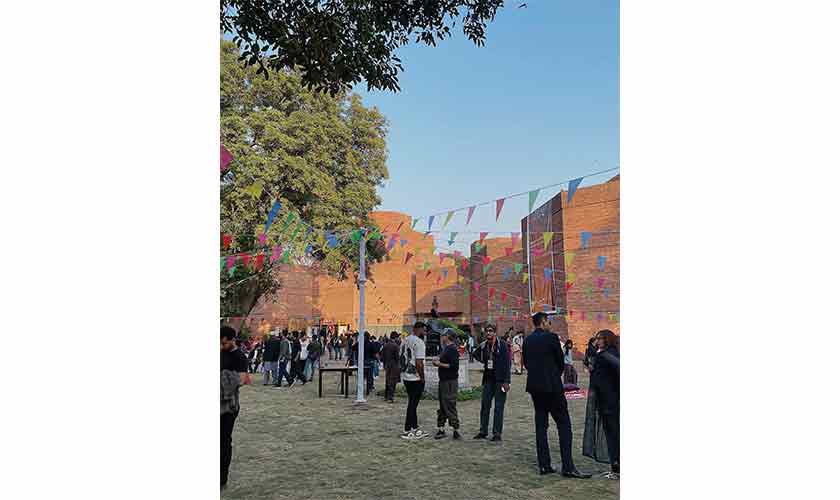
The 2025 iteration of the Lahore Literary Festival concluded February 23. Despite city-wide attention on the highly anticipated India-Pakistan cricket match, the festival remained well attended. Is that not the mark of a successful festival:drawing crowds to celebrate literature, even in the face of one of the year’s biggest sports events?
I was attending after a long absence – both from the festival and the country – since 2015, when I was still in school and perhaps unable to fully appreciate the significance of such events. LLF was the first time I had ever attended a panel discussion of any kind; where I was introduced to the work of Mona Eltahawy; and where I learnt that it was possible to foster a community in such a way in such times.
My day began with a session on Towards the Pebbled Shore, a collection of essays by the scholar and historian Syed Noman-ul Haq, in conversation with writer and translator Bilal Tanweer. A seminal scholar on Ibn Khaldun and Islamic history, Haq also has a deep command of Urdu poetry, a subject that features prominently in his essay collection. The discussion naturally shifted to his relationship with the poetic tradition and the audience were treated to verses of Iqbal and Faiz – poetry that was not only special to the author but also well suited to the atmosphere.
Commemorations of Urdu literature are never without some lamentation. Haq pointed out common phonetic mistakes we make when reciting significant works, such as those of Iqbal – errors that alter their intended effect. He described this as a loss of our language, a reduction in the way we think, and, ultimately, a diminishing of our understanding of our own heritage. He stressed the need to maintain a connection with the past and to preserve the indigenous intellectual tradition.
That said, Haq was not interested in pragmatic solutions to such problems. What was striking was that despite – or perhaps because of – his extensive scholarly training, he insisted that literature and poetry serve as nourishment for one’s inner life, a means to sustain one’s dreams.
As one in attendance and a writer, I was reminded not to confine literature to a static object but to see it as an ongoing, living conversation.
Is poetry a step towards becoming a fuller human being? The next session, launching M Athar Tahir’s poetry collection Telling Twilight, inadvertently sought to answer the question Haq had left behind. Moderated by Professor Navid Shahzad, the session was shaped by the personal friendship between Shahzad and Tahir. Their rapport added an intimate dimension to the discussion, offering the audience an insight into both the poet and his oeuvre that would not have been possible without Shahzad’s presence.
As an aside, the cover of the collection is a striking, eye-catching orange-red, featuring a simple pencil sketch of a young man. The drawing is by none other than Sadequain, making each copy a chance to own a piece by the esteemed artist.
Telling Twilight is a collection of 140 sonnets – an infamously demanding form in which the writer adheres to three quatrains (four-line stanzas) followed by a rhyming couplet. Off the top of my head, I cannot think of any contemporary poets, of any generation, willingly taking on this structure. Shahzad’s opening remarks, then, were fitting (and met with much laughter) when she asked, “Are you a glutton for punishment?”
Can one not ask the same question for all forms of writing?
Beyond Telling Twilight, Tahir’s previous work, the poetry collection The Last Tea and the novel Second Coming, were also discussed. The Last Tea is particularly innovative in its fusion of traditional stanzas with haikus, blurring the boundaries between body and soil, the personal and the atmospheric. Some poems are structured vertically, resembling written Japanese, others spill off the page as if they were the very flower petals they evoke, drifting away with a gust of wind.
I wholeheartedly agree with Shahzad’s remark, though it was made specifically about Telling Twilight: Tahir challenges not only himself in his writing but also his reader, drawing us into the same liminal space.
At the end of the day, LLF 2025 did not answer my initial question – what does it mean to be a writer? But why should it? As one in attendance and a writer, I was reminded not to confine literature to a static object but to see it as an ongoing, living conversation. We must continue to nurture our collective memory while allowing space for its inevitable lapses. Perhaps that is the closest we can come to an answer: creation is the restless, necessary work of keeping that link alive – to persist.