

Print Story
X




This year’s Faiz Festival revitalised spirits with spring breeze and thought-provoking discussions
| T |
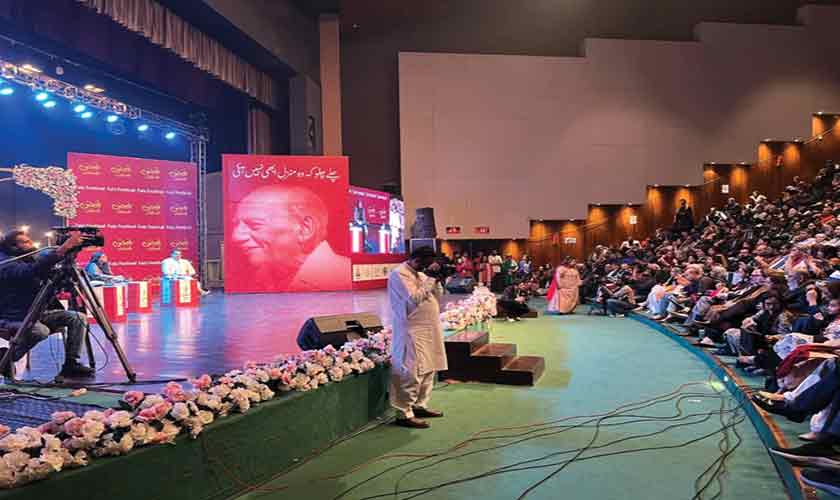
he three-day Faiz Festival 2025, held at Alhamra Art Council from February 14 to 16, commenced with a soul-stirring musical performance by Shafqat Amanat Ali. Around this time of year, the atmosphere takes on a distinct character, infused with the spirit of literature. The longing for justice, so deeply embedded in Faiz Ahmed Faiz’s poetry, seemed to reverberate through the crowd.
A captivating dance performance by young and enthusiastic performers from Lahore Grammar School set the pace for the days ahead. This was followed by one of the festival’s most engaging events, the Theatre Workshop. Under the supervision of Romaisa Shahid, Amal Ali Musa Khan and Muhammad Ali Musa Khan, the participants had the opportunity to explore the intricacies of performing arts.
Astri Ghosh, Dr Anjum Altaf and Prof Shaista Sonnu Sirajuddin reflected on the process of Translating Poetry in a thought-provoking session moderated by Ilona Yusuf. The discussion highlighted the significance of translation in preserving narratives and making them accessible to a wider audience.
As an audience member, I found myself viewing the process from a more critical perspective. The session raised important questions: How does a translator ensure that the indigenous idiom is preserved and conveyed faithfully? How essential is bilingualism (or multilingualism) for a translator to do justice to the original text?
Overall, the talk enlightened the audience with poetry translations that balanced literary interpretation with literal accuracy. It demonstrated the crucial role of translation in carrying narratives across linguistic and cultural boundaries.
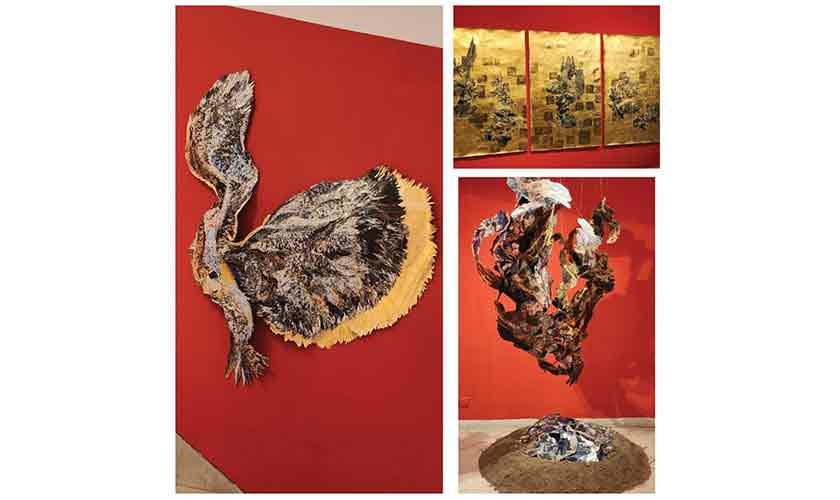
An art exhibition by Sarah Ahmad immediately caught my interest. Her collages were truly captivating, intricately weaving multiple discourses through her artistic expression. Tum Apni Karni Kar Guzro explores local and international traumas absorbed by the land and its inhabitants, shedding light on displacement in both the US and Gilgit-Baltistan. The exhibition situates these issues in broader patterns of colonial violence, dispossession and environmental injustice.
Ahmad’s work is deeply intertwined with nature, – its ability to heal and its recognition of the connective tissue that binds us to the earth. It speaks to connectedness between humans, the land and life. Her art reunites fragmented landscapes in a process of healing after displacement, both internal and physical. Destruction, in her vision, transforms into a landscape of renewed hope.
Ultimately, the exhibition pays tribute to the resilience of those whose spirits refuse to be crushed – those who carve a path through the wreckage, cultivating new futures out of loss.
Aleph Review provided an insight into its 8th issue, now available in print. The theme for this year’s anthology was Water, a key addition being reflections on Water in the Wilderness by Mehjabeen Abidi-Habib, Garstang, Rina Saeed Khan and Ayesha Vellani. This exploration offered a deep understanding of the interdependence between humans and nature.
The anthology encompasses a variety of expressions, extending beyond prose, poetry and translations to include visual art, interviews and book excerpts from a diverse range of credible, emerging and established literary and artistic figures.
Published annually, Aleph Review is available in both print and online formats. Submissions for this year’s edition are now open. The current theme is Of Monsters and Myths. The website says:
“Monsters and myths have been intertwined since humans first began weaving tales. They appear in lore as malformed beings (from the Old French monstre, mostre) or harbingers of evil (from the Latin monstrum); as Goliaths for Davids to slay, or shadow selves to contend with. Whether Frankensteinian creations or chimeric creatures, megalomaniacal leaders or xenophobic narratives, whatever form they assume in our myths, monsters hold up mirrors to society, compelling us to examine our values and our own inner demons.”
The editorial team consists of Mehvash Amin, publisher and editor-in-chief; Ilona Yusuf, associate editor; Hassan Tahir Latif, managing editor; Afshan Shafi, poetry editor; and Mina Malik, prose editor. Aleph Review provides a platform for writers to showcase their skills and creative expression.
The session Tribute to Bapsi Sidhwa revisited the literary tradition that amplified the voices of marginalised communities – a legacy powerfully established by Sidhwa. The panellists explored the far-reaching impact of her work and the compelling narrative techniques she employed.
By highlighting key themes in her most prominent novels, the discussion examined her portrayal of fragmented identities, peripheral voices and doubly marginalised communities. The session proved both enlightening and thought-provoking. Looking at the brighter side of her fictional narratives, the panel pointed to Sidhwa’s female characters, their resilience and unwavering agency.
Mina Malik, Dr Javaria Farooqui and Wajiha Hyder’ discussed Shazaf Fatima Haider’s novel A Woman on a Suitcase. The session was moderated by Musharraf Ali Farooqi. The conversation quickly evolved into an exchange of ideas, the three women lamenting women’s struggles in patriarchal societies and their frequent inability to claim space for themselves.
The novel delves into the harrowing realities of domestic and emotional abuse, shedding light on the turmoil a woman endures in a toxic relationship. The discussion revisited a recurring yet necessary conversation. It also underscored the importance of crafting challenging narratives that bring issues of family life into the public discourse.
At its core, the story follows a woman’s battle for self-reclamation and discovery, portraying the difficult but crucial journey of leaving an abusive marriage. The panellists appreciated the novel’s role in normalising the act of taking control of one’s own life, especially in the context of divorce, framing it not as failure but as a step towards empowerment.
The launch of Blood-Coloured Palestine revisited Edward Said’s Question of Palestine, offering a reflective exploration of historical and contemporary narratives. Amina Mufti praised the author’s ability to solidify historical accounts, particularly in reviving the past glory of the Ottoman Empire and bringing it to life.
The discussion problematised the question of Palestine. The panellists emphasised the importance of raising the awareness that love transcends divisions, instilling a sense of shared humanity. They highlighted the book as a testament to the inclusivity of sentiments – one that forges connections among people and bridges the gaps between nations. The book offers a fresh perspective, urging the readers to look beyond political and territorial divides.
Besides a historical account, the book presents a deeply personal and evocative narrative, reflecting the curiosity and passion of its author. It also comments on the symbolic power of Earth in uniting people from diverse backgrounds. The narrative calls for a United Palestine – one that upholds coexistence and inclusivity.
Amina Mufti also introduced the idea of translating the book into other languages to ensure its message reaches a wider audience.
The festival provided a much-needed break from the monotony of life, revitalising the audience’s spirit with the invigorating breeze of spring, accompanied by thought-provoking literary discussions.
The writer is a lecturer at the Department of English Language and Literature, Kinnaird College for Women, Lahore