

Print Story
X




Recent scholarship highlights Bhai Ram Singh’s role in designing famous buildings of the city
| T |
he history of the Indian subcontinent is replete with controversy. Some regions, epochs, events, dynasties, and persons get more importance and coverage than they deserve, while others are deprived of their due.
This can happen due to deliberate and directed efforts (mainly in the case of national history writing or curriculum preparation), or unintentionally (primarily due to lack of knowledge or information).
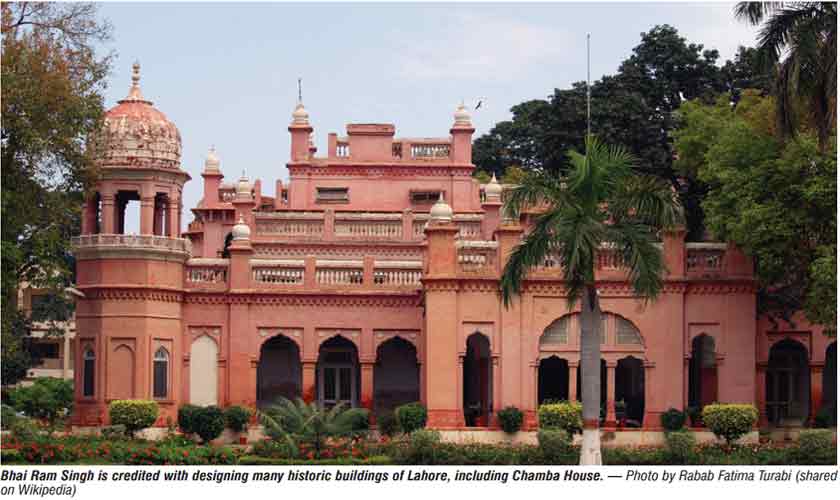
Similar misconceptions surround Sir Ganga Ram and Bhai Ram Singh. The latter is credited with designing many significant historic buildings of Lahore, including Aitchison College, Lahore Museum, University of the Punjab, Chamba House, the Albert Victor Hospital, and the Mayo School of Arts (now the National College of Arts). Recent publications including The Raj, Lahore, and Bhai Ram Singh (Pervaiz Vandal and Sajida Vandal, 2006) and Colonial Lahore: A History of the City and Beyond (Ian Talbot and Tahir Kamran, 2016) paint a different picture, crediting Bhai Ram Singh with the architectural design and Sir Ganga Ram with the construction of these buildings.
Sir Ganga Ram (1851-1927) was a civil engineer, though he also designed some buildings. Bhai Ram Singh (1858-1916) was chiefly an architect, who designed many significant historic buildings in Lahore.
A civil engineer is concerned primarily with the application of planning, designing, constructing, maintaining and operating infrastructure; protecting the public and environmental health; and improving neglected or inadequate infrastructure. An architect, on the other hand, plans, designs, and oversees the construction of buildings. To practise architecture means to provide services related to the design of buildings and the space within the site surrounding them that have human occupancy or use as their principal purpose.
Born in 1858 in a Ramgarhia Sohal family (a carpenter clan) in the Rasulpur village (near Batala, now in Indian Punjab), Bhai Ram Singh showed early talent. By the age of 16, he had achieved mastery as a craftsman and carpenter. This allowed him to prove his mastery when the wife of the deputy commissioner of Amritsar district called him to repair a piano. Despite being unfamiliar with the instrument, he successfully fixed it. Subsequently, on the recommendation of the deputy commissioner, he was enrolled in Mayo School of Industrial Arts, established by John Lockwood Kipling (a sculptor and painter trained in London who practised in Bombay). Under Kipling’s mentorship, Ram Singh integrated the European art theory with the Indian heritage of art and architecture.
Bhai Ram Singh showed early talent. By the age of 16, he had achieved mastery as a craftsman and carpenter.
After completing his education, Ram Singh became an assistant drawing master at the School. He eventually retired as its principal (the first native/ Indian to serve in this role) in 1913.
Besides teaching at the School, Ram Singh kept designing significant buildings. Between 1885 and 1887, he worked with Kipling, decorating the Indian Passage and ballroom at Bagshot Park for the Duke of Connaught, Queen Victoria’s third son, whom he had met in India when the duke was commander-in-chief of the Bombay Army between 1886 and 1890. This allowed him to become a part of the Osborne House Commission. The Commission was tasked with creating the Durbar Room at Queen Victoria’s residence at Osborne House on the Isle of Wight.
Admiring his work, his mentor Kipling said, “The designer had embarked on a new life in a new world.” Queen Victoria’s diaries describe him as “a very intelligent, pleasant, nice man; we looked at sketches he had made to decorate the room.” The Queen was so delighted with his work that she asked her court artist, Rudolph Swoboda, to paint Ram Singh’s portrait. The portrait now hangs in the Durbar Hall, Osborne House lobby.
| A |
long with designing and architecting royal buildings in the United Kingdom, Bhai Ram Singh also designed buildings in British India. He left a significant mark onthe architectural landscape of the colonial Lahore, Punjab, and India. Other than the buildings mentioned above, he designed College of Agriculture in Lyallpur (now Faisalabad); Islamia College, Peshawar; Khalsa College, Amritsar; and Governor’s House in Simla.
As executive engineer, Sir Ganga Ram constructed most of the buildings designed by him. Together, they shaped the pre-independence Lahore.
For his invaluable services, Bhai Ram Singh was awarded the titles of Sardar Sahib and Sardar Bahadur on January 1, 1907, and June 25, 1910, respectively. He passed away in 1916 in Lahore.
Bhai Ram Singh’s impact on the architecture of colonial Punjab in general and colonial Lahore in particular, can be gauged from the fact that all public buildings of the first half of the 20th Century carry echoes of his design values.
Mazhar Abbas, author of The Aftermath of the Bangladesh Liberation War of 1971: Enduring Impact (Routledge, 2024), has a PhD in history from Shanghai University. He is a lecturer at GCU, Faisalabad, and a research fellow at PIDE, Islamabad. He can be contacted at mazharabbasgondal87@gmail.com. His X-handle is @MazharGondal87