Print Story
X




The origin, development and history of Lohri are contested and debatable
| L |
ohri, a festival that has almost disappeared from Lehnda (western) Punjab in recent decades, was once celebrated in many cities (including Lahore, Rawalpindi and Lyallpur—now Faisalabad), towns and villages on January 13. This year the celebration received massive coverage on social media. Netizens, even those who could not celebrate it, hailed and appreciated the celebration and its coverage. This kind of celebration, greeting and appreciation marks the beginning of the revival of a lost cultural festival in the region. Despite its celebration in several parts of the province and its popularity on social media, many young people do not know Lohri’s history and significance.
Umair Abbas Ranjha, an enthusiastic advocate of the Punjabi language, culture and tradition, is one of my long-term close friends. He hails from a village in Sargodha district in central Punjab. He recently shared a video on WhatsApp showing Indian cricketer-politician Navjot Singh Sidhu celebrating Lohri with his family. Responding to this video, I explained some aspects of Lohri’s background and significance. Ranjha thanked me for educating him on this subject. This induced me to write a piece on Lohri’s history and importance, particularly to inform the youth unfamiliar with this cultural festival of the land of five rivers.
Lohri is a popular folk festival and a vibrant winter celebration rooted in Dogra and Punjabi folk traditions. Falling on the night of Maghi (the regional name of the Hindu festival of Makar Sankranti, celebrated in Nepal, the Punjab, Haryana, Himachal Pradesh and Jammu). It is generally celebrated on January 13th or 14th, a day before Maghi or Makar Sankranti. The Bikrami calendar (Punjabi or Desi Calendar) determines Lohri’s date, which changes every 70 years. It was celebrated on January 11th in the late 19th Century and January 12th or 13th in the mid-20th Century. It is celebrated on January 13th or 14th in the 21st Century.
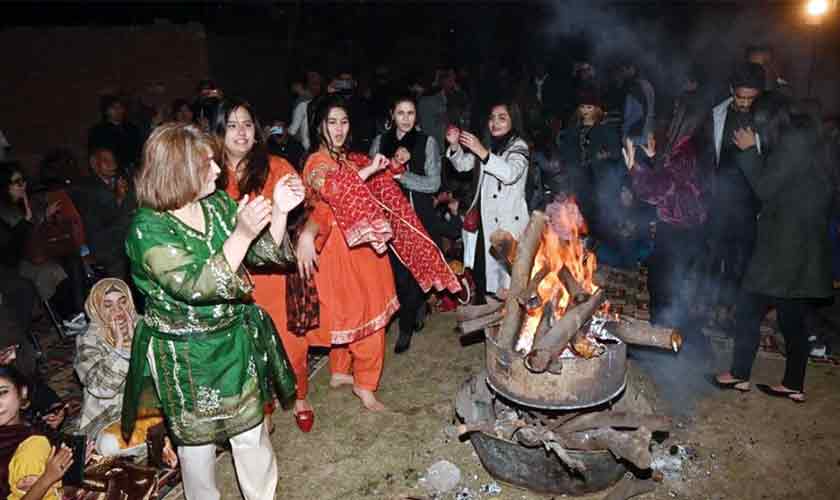
On the eve of Lohri, people gather around bonfires lit with wood and cow dung cakes in open spaces or the courtyardsof their homes. They circle the fire as a part of the tradition. They are served with rewri, jaggery, sugars, peanuts, sesame seeds, popcorn, and gazak (a dry sweet made of jaggery and sesame seeds), which they throw in the fire. Meanwhile, they sing Lohri songs and dance to the rhythm of dhol. They are also served with festive foods and exchange gifts as a token of love and affection.
The origin, development, and history of Lohri are contested. Various cultures and regions celebrating Lohri have different accounts of its origin, development and history. In the Punjab, Lohri is linked with the tale of Rai Abdullah Bhatti (popularly known as Dulla Bhatti) of Pindi Bhattian (now a part of Hafizabad district in central Punjab). He was a legendary hero of 16th-Century Punjab who led a rebellion against the Mughal Emperor Akbar, rejecting his regressive tax policies. Dulla launched himself as a revolutionary leader of the working class. Soon, he became a popular leader amongst the local community because of his bravery and promotion of social justice. Thus, like his father, Farid, and grandfather, Sandal alias Bijli, Dulla challenged Akbar’s rule in the Punjab.
On the eve of Lohri, people gather around bonfires lit with wood and cow dung cakes in open spaces or the courtyards of their homes. They circle the fire as a part of the tradition. They are served with rewri, jaggery, sugar, peanuts, sesame seeds, popcorn and gazak, which they throw in the fire.
The Mughals tried to capture him and crush the revolt. They failed in several attempts. Meanwhile, their local commander captured two Brahman girls, Sundri and Mundri, from Kot Nakka village near Pindi Bhattian—the centre of Dulla Bhatti’s revolt against the Mughals. This was done, along with other reasons, to humiliate Dulla Bhatti, who pledged to be the saviour of the people of this region.
Responding to this news, Dulla chastised the Mughal commander and his army by rescuing the girls. Afterwards, Dulla gathered his family and friends, as well as the family and relatives of the girls, to arrange their marriage ceremonies. For that purpose, a fire was lit with wood and cow dung cakes; the drummers played the drums; the songs were sung; the dance was performed; and delicious foods were served. In short, Sundri and Mundri were married with pomp and show. Lohri is celebrated to commemorate Dulla’s valour. His protecting the honour and lives of the Brahmin girls despite being a Muslim landlord himself is celebrated alike by Muslims, Sikhs and Hindus. A popular Lohri song goes: “Sunder Mundriye ho! Tera Kaun Vichara ho! Dulla Bhatti wala ho! (Oh, Sundri and Mundri! Who will think about you? He is Dulla Bhatti!).”
Lohri has multifaceted cultural and historical significance. First, it is a unifying event that brings together individuals from diverse religious backgrounds, including Sikhs, Hindus and Muslims. Second, it celebrates fertility, prosperity and good fortune, especially for newlyweds and families with newborns. Third, it marks the conclusion of the winter solstice, ushering in longer days and shorter nights with the sun shifting to the northern hemisphere. Fourth, it symbolises the harsh winter’s fading and the pleasant weather’s beginning—i.e., the end of the harsh winter and the start of the lovely spring. Fifth, Lohri is a festival celebrated for the successful harvest of winter crops like sugarcane, wheat and mustard, and the lighting of a holy bonfire marks it. Therefore, being a harvest festival, it is significant for families whose livelihoods depend on farming and agriculture. Sixth, it signifies a celebration of fire, symbolising warmth and light.
Most people celebrate Lohri believing it brings prosperity and wards off evil.
Mazhar Abbas, author of The Aftermath of the Bangladesh Liberation War of 1971: Enduring Impact (Routledge, 2024),” has a PhD in history from Shanghai University. He is a lecturer at GCU, Faisalabad, and a research fellow at PIDE, Islamabad. He can be contacted at mazharabbasgondal87@gmail.com. His X-handle is @MazharGondal87