EMPLOYMENT
It has been acknowledged in a number of international forums, including the 2005 World Summit, the 2006 UN Economic and Social Council, the UN Chief Executives Board of 2007 and by the UN Commission for Social Development, that making full, productive and decent employment for all, a central objective of relevant national and international policies and development strategies, is the main route to get the country out of poverty.
 Article 18 of the Constitution of Pakistan titled Freedom of Trade, Business and Profession prescribe the right of its citizens to enter upon any lawful profession or corporation, and to conduct any lawful trade or business without any gender discrimination. Several other articles have been included in the constitution to enable the environment conducive for the female population to enter and remain in the labour market.
In this way not only male but female labour force participation rate can play an important role for eradicating extreme poverty and hunger in the country. Since sex ratio in Pakistan is almost 100, as per the Pakistan Social and Living Standards Measurement (PSLM) data from 2011-12, it becomes mandatory for the females to work and actively participate in the labour force.
Female labour force participation not only improves the economic position of women and her house but also improves the overall efficiency and helps in developing the potentials of the country. Data shows that 84 percent of educated married women between the ages of 15-49 are still out of the labour force (PSLM 2011-12).
This raises the question as to what forces stop these educated women from actively participating in the labour force. One of the main force is the person who has the decision making power to either let the educated married women enter into the labour market or remain at home to do the household work all day.
The PSLM data (2011-12) refers to this person as the ‘Head of the Household’, mostly a male member of our society whether a father or a husband. In most of the cases he decides alone, sometimes in consultation with other family members whether spouse or other male members of the family, and at times in consultation with the women concerned.
Whether he decides alone or in consultation with anyone else, he is the only person who is playing a pivotal role in the economic life of the educated married women. He is the only person who is deciding the economic progress or economic retreatment of the educated married women in our society. He is the person who is not letting the educated married woman fully participate in national life by joining any profession, business or trade.
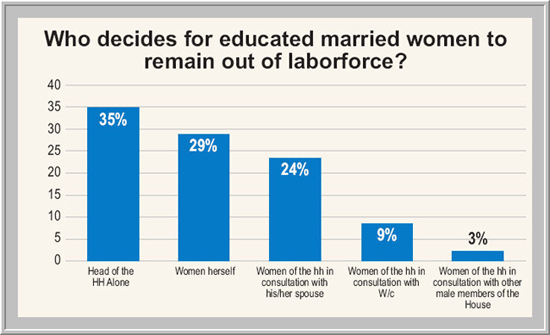
Data shows that it is the decision of the head of the household alone that restricts 35 percent of the sample educated married women outside the labour force; and in case of the Pakistani society, it is mostly the husband or father-in-law of the married woman who plays this role.
The second most important role is being played by the mother-in-law, as the data shows that it is the decision of the head of the household in consultation with his/her spouse that restricts 24 percent of the total sample of educated married women from joining the labour market.
However, at least 29 percent of the educated married women, who have a choice to decide whether to join the labour force or not, remain out of the work force, which shows that they are not interested in working. The data set shows that only nine percent of the total sample of the labour force of educated married women are consulted before taking any decision in this regard. Other male members too are consulted for letting or not letting a woman participate in the labour force, however, this group is only three percent of the total. In this case, the head of the household consults other male members of the house before taking any decision regarding the woman’s labour force participation.
For analysing the data on the basis of education level of the women out of labour force, we divided the data into six levels of education - secondary level that is matriculation, technical education level which means polytechnic diploma, graduation, MA/MSC, degree level that is degree in engineering, medicine, agriculture or law. Here we found that 36 percent of the total married out of labour force women having a degree level education can decide by themselves about joining or not joining any profession or work for economic benefit, however 45 percent are those for whom the decision is taken by the head of the household alone. Those with MA/MSC and graduation level education constitute 32 percent and 33 percent respectively, and decide by themselves.
While 27 percent and 26 percent are those who have technical and secondary level of education, surprisingly, the women having top level of education, ie, MPhil/PhD, cannot decide by themselves to work or not to work in the labour market.
Analysis shows that overall decision making is in the hands of the head of the household who in the case of married women is the husband or father-in-law. Second most influential role is being played by the spouse of the head of the household that is mostly the mother-in-law.
Generally, decision making is one of the indicators to measure the empowerment of women where an educated woman is perceived to be more empowered than an uneducated one or one having low level of education. However, there are disruptions. It has been found through analysis that though women with degree level education (including graduation, MA/MSC and professional) are more empowered than those who have only secondary and higher secondary level education, those women with the highest level of education (MPhil/PhD) are not empowered enough to take decisions about their career in the labour market.
In Pakistan, the decision regarding MPhil and PhD women’s participation in the workforce is being taken by the head of the household in consultation with other male members of the house, and head of the household alone, 58 percent and 42 percent, respectively.
In some cases, the woman concerned is also consulted, but mostly those women are the ones who have technical education or a professional degree, like a degree in engineering, medicine, agriculture or law. This also shows that women with professional degrees are more empowered than others.
The point to be pondered on is why the 38 percent (including 29 percent those who decide themselves and nine percent those who are consulted) of the total educated married women are out of the labour force?
Also, what compels the head of the household to keep an educated married woman out of the labour market? There is a need to find out the reasons behind it, as it is inevitable for the government of Pakistan to resolve the issue otherwise.
The government also needs to invest in awareness campaigns for the out of workforce women as well as heads of households, spouses, and other members who play a negative role by keeping educated women out of the labour market and thus hindering economic growth.
It is also compulsory for the government to provide a positive environment to the educated married women to join the labour market, including strengthening laws that protect a woman in the workplace.
The writer works at the Planning Commission