
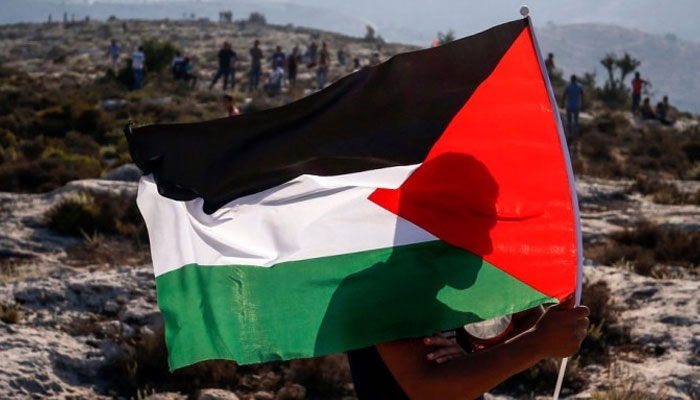
LONDON: British Prime Minister Sir Keir Starmer has confirmed the UK’s recognition of a Palestinian state in a historic, if largely symbolic, move, which he said was intended “to revive the hope of peace for the Palestinians and Israelis”.
The move comes ahead of the UN General Assembly this week, with other nations, including Australia and Canada, making similar moves shortly before Sir Keir’s announcement. The deeply symbolic move comes seven decades after the end of the British mandate in Palestine and the formation of the state of Israel.
The UK government has acknowledged that recognising a Palestinian state would not ease the humanitarian crisis in Gaza nor contribute to the freeing of the hostages taken by Hamas. But the UK believes the move is necessary to safeguard the prospect of a lasting two-state solution to the Middle East conflict, with Israel existing alongside a Palestinian state.
Israeli Prime Minister Benjamin Netanyahu branded the move “absurd” and “simply a reward for terrorism”.
In an effort to counter that criticism, Sir Keir said Hamas was a “brutal terror organisation” and confirmed plans to ratchet up sanctions on the group. “Our call for a genuine two-state solution is the exact opposite of their hateful vision,” he said.
But with the humanitarian crisis in Gaza escalating and Israel pushing ahead with settlements in the West Bank, Sir Keir said “the hope of a two-state solution is fading” but “we cannot let that light go out”. He said the “moment has now arrived” to recognise a Palestinian state.
In a video message, he said: “Today, to revive the hope of peace and a two-state solution, I state clear as prime minister of this great country that the United Kingdom formally recognises the State of Palestine. We recognised the State of Israel more than 75 years ago as a homeland for the Jewish people. Today we join over 150 countries who recognise a Palestinian state also. A pledge to the Palestinian and Israeli people that there can be a better future.”
The war against Hamas since the October 7, 2023 atrocities has fuelled division in the UK.
It has also caused political pressure for Sir Keir, both from his own backbenchers and from the electoral challenge posed by pro-Palestine independents, who took Labour scalps at the general election.
Sir Keir said: “I know the strength of feeling that this conflict provokes. We have seen it on our streets, in our schools, in conversations we’ve had with friends and family.
“It has created division. Some have used it to stoke hatred and fear, but that solves nothing. Not only must we reject hate, we must redouble our efforts to combat hatred in all its forms. We must channel our efforts, united together in hope, behind the peaceful future that we want to see: the release of the hostages, an end to the violence and an end to the suffering and a shift back towards a two-state solution as the best hope for peace and security for all sides.”
The UK’s recognition of Palestine comes as part of an internationally coordinated effort. More than 150 countries are expected to have recognised Palestine by the end of next week, although some may set conditions.
Australia’s Prime Minister, Anthony Albanese, said: “Further steps including the establishment of diplomatic relations and the opening of embassies will be considered as the Palestinian Authority makes further progress on commitments to reform.”
The Canadian prime minister, Mark Carney, said: “Recognising the state of Palestine, led by the Palestinian Authority, empowers those who seek peaceful coexistence and the end of Hamas. This in no way legitimises terrorism, nor is it any reward for it.
“While Canada is under no illusions that this recognition is a panacea, this recognition is firmly aligned with the principles of self-determination and fundamental human rights reflected in the United Nations Charter, and the consistent policy of Canada for generations”.
A spokeswoman for Israeli Prime Minister Benjamin Netanyahu said Hamas did not want a state alongside Israel “they want a state instead of Israel”.
She said Mr Netanyahu’s message to nations recognising Palestine was “the people of Israel aren’t going to commit suicide because of the political needs of European politics”.
The Israeli foreign ministry said in a statement: “Recognition is nothing but a reward for jihadist Hamas.”
The issue is likely to dominate the gathering of world leaders at the United Nations in the coming days, with France expected to formally recognise Palestine on Monday at the UN General Assembly.
Deputy Prime Minister David Lammy, who will represent the UK at the UN gathering, acknowledged there would be little immediate change from recognition. “It’s not to say as night follows day, you recognise one day and a Palestinian state appears the next,” he told Sky News.
But the move will see the UK recognise a Palestinian state based provisionally on 1967 borders, before Israel occupied the Gaza Strip and West Bank. It will also pave the way for full diplomatic relations, with the Palestinian head of mission in the UK likely to be upgraded to full ambassadorial status.
The Board of Deputies of British Jews said there would be “deep dismay” about the announcement across the Jewish community.
In a statement, the board said: “As we feared and warned, the way the UK has chosen to recognise a Palestinian state has done nothing to advance a ceasefire, free the hostages, stop the suffering of Palestinians in the Gaza Strip, or advance long-term peace.
“It may have set those goals back, by reducing pressure on Hamas and enabling them to claim recognition as the ‘fruits’ of its violence and intransigence.”
Tory leader Kemi Badenoch said, “We will all rue the day the decision was made” as it was “rewarding terrorism with no conditions whatsoever put in place for Hamas”.
“It is because Labour cannot fix the big problems in our society that they focus on discredited student union campaigns to appease the hard left,” she said.
Liberal Democrat leader Sir Ed Davey said it was a “historic day” adding: “The government now needs to follow through and do all it can to secure a ceasefire, an end to the cycle of violence and a two-state solution which is the only way to ensure a permanent end to the conflict.”
London mayor Sir Sadiq Khan said recognising a Palestinian state will show people in Gaza that they have “not been forgotten about”.
Asked how the symbolic move would affect people living in Gaza, Sir Sadiq said: “Well let’s not underestimate the importance of symbolism. I’ve spoken to people who have family in Gaza, and they know what’s happening around the world.
“It’s really important for them to understand they’re not suffering in silence. They’ve not been forgotten about.”
Recognising a Palestinian state would allow the status of diplomatic missions to be upgraded.
Currently, the Palestinian Authority delegation to the UK is not of embassy level and operates as a “diplomatic mission” based in Hammersmith, West London.
Embassy status would give the delegations protection and privileges under the Vienna Convention on Consular Relations and the Vienna Convention on Diplomatic Relations.
The FCDO said the Foreign Secretary will write to her Palestinian counterpart in “due course to lay out the process for establishing full diplomatic relations”.
The Muslim Council of Britain welcomed the UK formally recognise the State of Palestine. It said for decades, Palestinians and their allies have called for this recognition, and today we acknowledge this long-overdue step towards justice.
Dr Wajid Akhter, Secretary General of the Muslim Council of Britain said: “Recognition is welcome, but words must be matched by deeds. The British public will rightly ask: how does recognition sit alongside continued arms sales, military cooperation, and record levels of trade with Israel? True recognition requires an end to complicity in war crimes. Both the International Court of Justice and a recent UN Commission of Inquiry have found there are reasonable grounds to conclude that Israel is committing genocide in Gaza. Against this backdrop, recognition without meaningful action risks emboldening an extremist government while failing to uphold Britain’s international obligations.
Dr Akhter continued: “This step should mark the beginning, not the end, of Britain’s moral responsibility. We call on the government to accompany recognition with tangible action: an immediate halt to all arms sales to Israel, a reassessment of trade agreements, and full support for international justice mechanisms such as the ICJ and ICC. Only then can recognition carry real meaning.”



-
 State institutions ‘fail’ to perform constitutional duties: KP CM
 -
 CTD orders psychological testing of police on VVIP security duty
 -
 Navy busts drug consignment valued at $130m
 -
 Three ex-secretaries in race for ETPB chief post
 -
 Punjab govt forms 71 JITs to probe cases against banned TLP
 -
 Some UNSC members ignoring broader reforms, seeking privilege: Pakistan
 -
 PAC body discusses non-recovery of Rs15bn gas cess
 -
 Pakistan received $2.29bn foreign loans in first 4 months of 2025