
 |
| |
WEEKLY
SECTIONS |
 |
|
 |
| Tehran not opposed to sending uranium abroad |
 |
 |
 |
Ahmadinejad gets mly honours in Bolivia
Wednesday, November 25, 2009
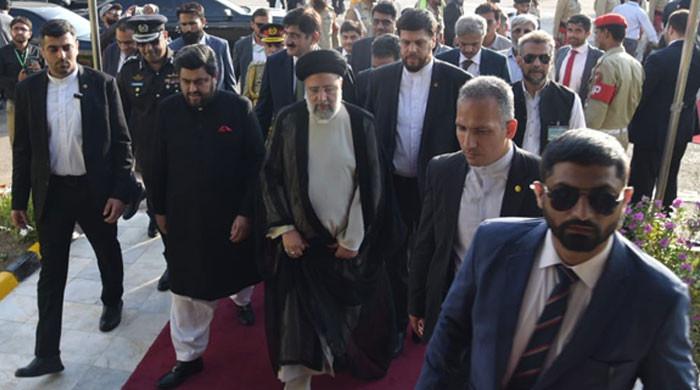
LA PAZ/TEHRAN: Iranian President Mahmoud Ahmadinejad arrived in Bolivia for a short visit on Tuesday, the second leg of a Latin America tour of three leftist nations sympathetic to his administration. He was greeted at the airport with full military honours by President Evo Morales.
Ahmadinejad began his itinerary on Monday in Brazil, where his host, President Luiz Inacio Lula da Silva, reiterated support for Iran’s controversial nuclear energy programme.
However Lula also urged his Iranian counterpart to keep talking with Western countries that feared the programme was a cover to build atomic weapons.
Iran should “continue contacts with interested countries for a just and balanced solution on the nuclear issue in Iran,” said Lula, a moderate leftist in command of Latin America’s biggest economy.
Ahmadinejad’s visits to Bolivia and, late on Tuesday and into Wednesday, to Venezuela were to shore up ties with countries whose leaders are, like him, overtly hostile to the United States.
An advance party of Iranian businessmen representing 70 companies prepared the ground in Venezuela’s capital Caracas on Monday for trade discussions.
“We have a solid foundation, a solid base that we have created over this decade in our relationship, and it shows how false are the attacks of the world empire,” Venezuelan Foreign Minister Nicolas Maduro said in a broadcast shown by state television network VTV. The “empire” he referred to was the United States.
Venezuela’s Jewish community on Monday, though, expressed its displeasure over Ahmadinejad’s visit, issuing a statement in which they called the Iranian leader an “ominous” person who, if not stopped, “could cause serious harm to humanity.”
His visit “gives legitimacy to a regime about which there are serious doubts over its transparency and legality,” the group said.
Meanwhile, top Iranian officials said earlier on Tuesday that Tehran is ready to send its low-enriched uranium abroad provided there is simultaneous exchange on its own soil of nuclear fuel processed by world powers.
Such an arrangement, they said, would guarantee that Tehran would receive the fuel required for its research reactor.
“The guarantee sought by the Islamic republic is to have simultaneous exchange of fuel in Iran,” Iran’s vice president and atomic chief Ali Akbar Salehi told the official IRNA news agency.
“We will not accept any imposed conditions and we will also not accept that we are treated as an exceptional case,” he said.
Foreign ministry spokesman Ramin Mehmanparast said Tehran is ready to send off its 3.5 per cent low-enriched uranium (LEU) but would want a simultaneous exchange on its soil with 20 per cent pure uranium processed abroad.
“Iran is not opposed to sending uranium abroad, but is considering how to do that,” Mehmanparast told a news conference.
He said Tehran wanted a “100 per cent guarantee” that it would receive the fuel required for its research reactor and “one of the guarantees is a simultaneous exchange of fuel inside the country.”
Iran and world powers have been at loggerheads for weeks, failing to reach a nuclear fuel deal aimed at allaying Western concerns over Tehran’s nuclear programme.
The West, led by Washington, fears Iran might otherwise covertly divert its LEU for further enrichment to the much higher levels required for a bomb, an ambition Iranian officials strongly deny.
Enrichment of uranium lies at the heart of the controversy, as the material can be used to power nuclear reactors as well as to make the core of an atom bomb.
To defuse the crisis, the UN atomic watchdog brokered a deal last month under which Iran would send 1,200 kilograms (2,640 pounds) of LEU, or 70 per cent of total stocks as of October, to Russia and then France for conversion into fuel required for the internationally-supervised Tehran reactor.
But Iran has rejected that deal amid stiff opposition from senior officials who oppose sending the LEU in one go. They fear the West might renege on its side of the bargain. Mehmanparast underscored that, saying Iran wanted such a guarantee because “the countries we are dealing with do not have good records in our public opinion.” “They have not lived up to their expectations and it has kind of created mistrust.”
|
|
 |
| Back
| Send
this story to Friend | Print
Version |
 |
|
|