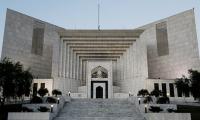

ISLAMABAD: The landmark SC judgment on the NAB chairman’s appointment has closed all doors for the Presidency as well as the government, present or future, to turn the anti-corruption apparatus into a tamed body for the rulers. The apex court clearly concluded that those facing inquiries could not be given the right to make such a crucial appointment.
The judgment leaves no room for the ruling Zardari-Gilani duo to continue using NAB to cover up corruption instead of curbing it. Written by Justice Asif Saeed Khan Khosa, it said: “The National Accountability Bureau, which happens to be a premier and high-profile anti-corruption institution of the country, started being perceived as an institution which was possibly being misused for covering up corruption at high places and such cover-up was perceived to be controlled and managed through appointment of its handpicked chairman.”
The Presidency has now not only lost its darling chairman Justice (r) Deedar Shah but is simply out of the official loop, which is now relevant for the appointment of impartial, fair and independent chairman NAB.
The question now is whether the government will continue with the status quo or abolish the headless NAB because the future NAB chairman would now be appointed only after a meaningful consultation between the Prime Minister, leader of the opposition and the Chief Justice of Pakistan.
Although President Zardari did not mention corruption in his annual address to the Parliament’s joint sitting, the Supreme Court in this judgment underlined it as an “unfortunate bane of our society” and hinted that even the high public offices are facing serious corruption allegations.
The court also addressed the fundamental question: “How those facing corruption charges and sitting in high public offices could be entrusted the power to make their choice appointment of anti-corruption apparatus’s head.”
The judgment said: “...Corruption being an unfortunate bane of our society in the current phase of our history and even the high public offices being not immune from serious allegations in that regard, leaving the matter of appointment of the head of the most important anti-corruption institution in the country in the hands only of those very persons who could possibly, in future or present, be a subject of inquiries, investigations or trials for corruption would, apart from giving rise to the issue of conflict of interest, defeat the very object of the relevant law and would, thus, also prejudicially affect, directly or indirectly, the fundamental rights of the citizens at large.”
The NAB, which during Musharraf’s tenure was used to victimise the opposition, has become totally irrelevant as an anti-corruption body under the present regime. The present NAB, on the one hand, started closing past corruption cases (including the NRO cases against the ruling elite) and, on the other, it is massively being used to cover up the corruption scandals of the present regime. It has practically become a corruption-protecting agency.
The inclusion of the Chief Justice among the three consultees has left no chance for any possible understanding between the government and the opposition for the appointment of a pliable NAB Chairman, as has been the case in the past and most recently in the case of Syed Deedar Hussain Shah.
Justifying the role of the CJP as one of the consultees, the judgment said: “.....the Chief Justice of Pakistan comes in as a consultee in his capacity as a guardian and defender of the constitutional and legal rights of the people at large. The Chief Justice of Pakistan can also play a salutary role in the matter of such appointment particularly when there is a serious difference of opinion between the other consultees over a proposed appointment of chairman, National Accountability Bureau.